


The Office of the Inspector General
The Defense intelligence Agency's (DIA) Office of the Inspector General (OIG) is one of 74 Federal statutory Inspectors General (IGs) established by the IG Act of 1978, as amended. The IG Act contains provisions for OIG independence, the objectivity of OIG work, and safeguards against efforts to impair that objectivity or hinder OIG operations. Mr. Jeremy Kirkland became the Inspector General on June 4, 2023.
Headquarters
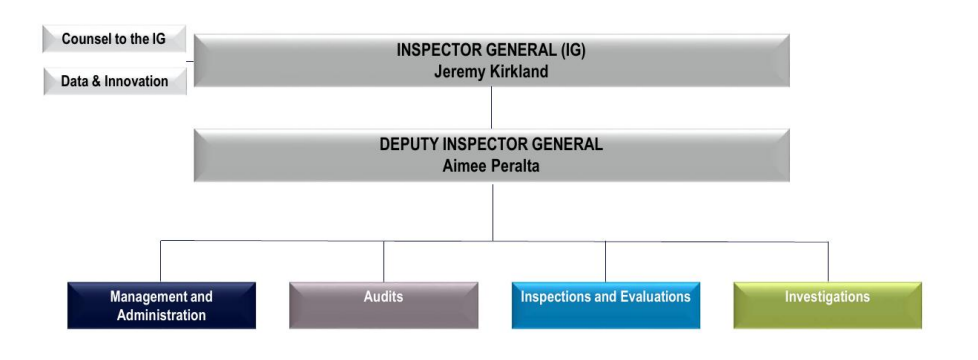
Headquarters comprises the Inspector General (IG), Deputy IG (DIG), Counsel to the IG (IGC), and the Data and Innovation (D&I) team. The IG serves as the principal leader of the OIG, responsible for overseeing all audit, inspection, evaluation, and investigative functions. The IG ensures that OIG activities are conducted with integrity, promoting efficiency, effectiveness, and accountability within the Defense Intelligence Agency (DIA). The IG also communicates findings and recommendations to both DIA leadership and Congress. The DIG assists the IG in managing OIG operations and may assume the role of the IG in their absence. The DIG plays a critical role in coordinating the various OIG divisions, ensuring that audit and investigative priorities align with the Agency's objectives.
IGC provides independent and objective legal advice and counsel to the IG directly and to all OIG elements on a variety of legal and policy issues that impact the OIG mission. IGC reviews all new and revised policies and legislative proposals for impact on OIG's roles and responsibilities. IGC also serves as the DIA Whistleblower Protection Coordinator. Additionally, IGC oversees OIG's processing of Freedom of Information Act and Privacy Act requests.
The D&I team consists of data scientists, data architects, data engineers, and a strategy program manager. D&I spearheads the OIG's data and analytical services, enhancing operations, supporting strategic decision-making, and improving oversight activities. The D&I team collaborates with internal and external stakeholders to identify and acquire effective data tools and techniques, while also facilitating innovative solutions to enhance OIG products, processes, and performance.
Moreover, D&I is vital in shaping the OIG's strategic direction by creating and publishing the OIG Strategy and the OIG Strategic Implementation Plan. The staff also leads the development of the Agency's Top Management Challenges and Emerging Risks Report, as well as the OIG Annual Plan. These products are mandated by Congress or established by law.
OIG Headquarters staff also manages strategic engagements that enable the IG to keep the Director, DIA, and Congress fully informed about problems and deficiencies relating to the administration of Agency programs and operations and the necessity for and progress of corrective action, as required by the Inspector General Act of 1978.
Audits
The Audits Division conducts independent, objective, and nonpartisan oversight of the stewardship, performance, or cost of DIA’s operations, programs, and policies. Audits provide essential accountability and transparency over government programs and enable decisionmakers to improve program performance and operations, reduce costs, facilitate decision making by parties responsible for overseeing or initiating corrective action, and contribute to public accountability.
Inspections and Evaluations
The Inspections and Evaluations Division (I&E) conducts systematic and independent assessments of the design, implementation, and results of DIA's and the Defense Intelligence Enterprise’s operations, programs, and policies. The division offers a flexible and effective mechanism for conducting oversight utilizing a multidisciplinary staff and multiple data gathering and analysis methodologies. Through its projects, I&E provides factual and analytical information. In addition, I&E measures performance; assesses internal controls; identifies savings opportunities; highlights best practices; evaluates intelligence oversight matters; assesses and refers allegations of fraud, waste, abuse, and mismanagement; as well as determines compliance with applicable laws, regulations, and policies.
Investigations
The Investigations Division (INV) conducts proactive and reactive administrative and criminal investigations to detect, deter, and report fraud, waste, and abuse within DIA. INV develops sufficient evidence to successfully resolve all allegations, and when appropriate, facilitates successful criminal prosecution or management-directed disciplinary action. The division identifies and reports internal control weaknesses that could render DIA programs and systems vulnerable to exploitation. Investigations, at its discretion, investigates questionable intelligence activities, as defined by Executive Order 12333, “United States Intelligence Activities,” as amended.
Hotline Program
The Hotline Program is a confidential and reliable means for DIA personnel and the public to report fraud, waste, mismanagement, and abuse of authority within DIA and intelligence enterprise operations. The program’s primary role is to receive and evaluate concerns and complaints and to determine whether to investigate or to refer to Agency management officials or to refer to the Agency element best suited to take action. To be effective, the program requires all personnel to be vigilant against illegal or improper acts and report any improprieties to the chain of command or an OIG representative. Check out the back side of this brochure for reporting guidance.
Management and Administration
The Management and Administration Division (M&A) provides advisement, guidance, and integrated institutional support on key mission-critical functions that enable OIG components to conduct their work efficiently and effectively. This responsibility includes managing budget and acquisition, human resources, space, information technology, strategic communications, and production, comprising editorial support and graphic design. Additionally, it includes staff operations, encompassing an array of administrative support services. M&A strives to create and improve administrative and business processes to meet the challenges of a dynamic working environment.